Model LS15, Battery-Operated, Hand-held and, International
Telephone Line Simulator, CO Simulator Providing Ring Signal, Loop Current/Loop
Voltage, Call Progress Tones, Programmable Telephone Numbers with Caller-ID
Signals (US and ETS) and Random Noise Generators For
Simulation of the Long-distance Telephone Lines
E-mail: sales@microseveninc.com
Introduction:
Micro
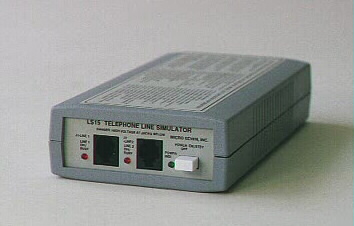
Seven Model LS15, Hand-held International Telephone Line Simulator, provides
battery operation as well as AC/DC adapter operation. The model LS15 with
international power adapter option is intended to be used all around the world.
The international power adapter option provides four different power plugs
(US/Japan, BK, Australian, and European) in 90-250V AC. Because it is
battery-operated unit, the application include modem
and telephone sets testing in engineering, manufacturing, and fields, emergency
telephone equipment, telephone line simulators for telephone line installers,
and dedicated telephone lines for various outdoor activities including athletic
events. The LS15 contains dual frequency call progress tones, 20Hz sine wave
ring signal, programmable loop voltage, short primary or programmable secondary
telephone number, caller-ID generation, caller-ID on call-waiting generation,
stutter dial tone, Visual Message Display messages, 1kHz test tone, distinctive
ring signals, and many other test tones. The LS15 also contains line-impairment
mode with extra insertion losses and random noise added for long-distance
telephone lines. The programmable parameters include caller-ID name and
telephone numbers, privacy/out-of-area, single/multiple message format, date
and time, battery voltage of 20 or 40 V, and many CW-CID parameters. All the
programmable parameters are restored back after the power to LS15 is turned.
The model LS15 also includes the Sleep mode, a power-saving feature, where the
power is shut down when both lines are on-hook for certain period. Therefore,
the power switch of LS15 may be left on indefinitely consuming little power.
The model LS15 is small and light that technicians may carry it on their
shoulders or on waist belts with an optional case. The rechargeable battery
inside LS15 provides several hours of battery-power operation, and the battery
may be recharged overnight with a provided AC/DC adapter. The LS15 may also be
operated by provided AC/DC Adapter or an external DC source with Car Battery
Adapter. A carrying case, Car Battery Adapter, and international power adapter
option providing four different power plugs (US/Japan, BK, Australian, and
European) are available as options. The LS15 is also equipped with a
forced-disconnect feature where disconnect signals are sent to calling and
called lines. The duration of the disconnect signal is also programmable.
Programmable network response delay simulates time delay after completion of
dialing. Simulated PBX mode returns dial tone after dialing 9. The secondary
call progress tone generates a single-frequency tone instead of dual-frequency
call progress tone. Programmed parameters are still restored for model LS15
without battery.
A lower cost model LS15-C
without caller-ID and other features is also available.
SPECIFICATIONS
Note:
all programmed parameters are stored in non-volatile memory except for hot-line
mode.
Dialing
telephone numbers: 1. Primary telephone number as a factory default
2. Secondary telephone number: A secondary telephone number is same as a
calling number in caller-ID. A telephone number can not
start with 0.
Dialing
Method:
DTMF
signal power: -13dBm to +5dBm per a frequency with no more than 4dB different
between frequencies.
DTMF dialing detection time: 45 ms
Pulse dialing: Break period: 45 to 75 ms (60 ms nominal)
Make period: 30 to 60 ms (40 ms
nominal)
Simulated
PBX Mode: By dialing "9", dial tone returns when the Simulated PBX
Mode was selected.
Line
Characteristics: Input impedance at 1 k Hz: 600 ohms +/- 5%
Signal Bandwidth: 150 HZ to 3.5 k HZ
Line
Impairment Mode: Line impairment circuit with additional 20dB of insertion loss
and -55dBm of random noise are added to signals between line 1 and 2. Random
noise amplitude is also programmable. Frequency attenuation characteristics and
envelope delay distortion of signals are not affected.
Random
noise amplitude programming: The random noise amplitude is set at –55 dBm as a
factory default value.
Battery-feed
voltage (loop voltage): Selection between -20 or -40 volts:
Ring
Signal: 20 +/- 2% Hz sine wave. Normally the ring signal duration is 2 sec on 4
sec off. Programming of distinctive ringing signals are installed.
Amplitude: 67V RMS into open circuit. It is 66 V RMS into RN=0.1, 56 V RMS into
RN=0.5, 48V RMS into RN=1, and 40V RMS into RN=1.7.
Distinctive
ring signal features:
(a). 2 sec on/ 4 sec off (default condition)
(b). 0.8 sec on, 0.4 sec off, 0.8 sec on, 4 sec off
(c). 0.4 sec on, 0.2 sec off, 0.4 sec on, 0.2 sec off, 0.8 sec on, 4 sec off
(d). 0.2 sec off, 1 sec on, 0.2 sec off, 0.3 sec on, 4 sec off
Off-hook
impedance requirement: 400 ohms maximum DC, 600 ohms nominal AC
Call
Progress Tones:
Standard dual-frequency call progress tones: nominal -16 dBm.
Dial Tone: 350 Hz + 440 Hz, continuous unless programmed for stutter dial tone
Ring-back Tone: 440 Hz + 480 Hz, 2 sec ON/4 sec OFF.
Busy Tone: 480 Hz + 620 Hz, 0.5 sec ON/0.5 sec OFF.
Accuracy in frequency component: +/- 1%.
Secondary Call Progress Tones: (480 Hz +/- 1%)
Secondary call progress tones with single frequency tone of 480 Hz may be
selected instead of generating dual frequency call progress tones. The signal
power is –18.5 dBm.
Stutter
dial-tone: enabled/disabled
Line
Input Jacks: USOC-RJ11-C, standard modular phone jacks
Power
Switch
Built-in
Battery: The battery is charged when the LS15 power switch is off.
Battery Capacity: 2.5 hours of battery operation with maximum load of both
lines off-hook.
Recharging time: 24 hours
Charge/discharge cycles: 100 times minimum
Hot
Line Mode: In hot Line mode lifting a handset at line 1 or line 2 calls the
other line without dialing.
Network
response delay: Time delay between the end of dialing and ring-signal
application is programmable.
Forced
called-party disconnect: When two lines are connected and one line hangs up,
disconnect signal is generated to both calling and called lines.
Programmable
disconnect signal: The disconnect signal, which is interruption of loop current
at the end of call is programmable.
Sleep
Mode (Automatic Power Shut-Down ): The Sleep mode is
enabled as a factory default condition. When both lines are idle (on-hook) for
more than thirty seconds, it enters into the Sleep mode by saving power
consumption down to a minimum amount
AC/DC
Adapter: 117VAC +/- 5%, or 220VAC +/- 5%(for 220V
unit)
AC/DC
Adapter or Car Battery Adapter input (also as a battery charger): 12VDC
(unregulated voltage), 800mA maximum
Line
Status Display: red LED for each line to indicate off-hook status (continuous
on) or ringing status (blinking)
Calibration:
not required
Power
On Indicator: green LED display on front panel,
steady-blinking to indicate low-battery condition, dim-blinking to indicate
that the battery charge is almost gone.
Dimensions:
19 cm (4") W x 4.5 cm (1.75") H x 10 cm (7.5") L
Weight:
500g (1.1 LBS.)
Environmental:
Operating temperature: 0 to 35 degree C, Humidity: 85% RH at 35 degree C
Warranty/Service:
6 months limited warranty. No warranty if any factory seal is broken.
Service
is performed at the factory, usually within 5 working days.
On-hook
and off-hook (call-waiting caller-ID) caller-ID FSK Generation:
Single message and multiple message-format caller-ID FSK generations are
supported. Programming parameters includes telephone number, name, date and
time, telephone-number length, name length, privacy/out-of-area, call qualifier
on/off, visual message on/off, marking period before FSK data, silence period
after the first ring, continuous caller-ID generation on/off, and wrong
checksum generation on/off. No ring signal is produced for the visual messages.
It also includes an FSK data expansion capability of caller-ID data.
Caller-ID
Signals: Frequencies: 1200Hz +/- 2 Hz, 2200Hz +/- 5Hz
Signal power: -14dBm into 600 ohms
Dialing 048 repeats caller-ID sequences.
Programmable
parameters for caller-ID:
Date + Time
Telephone number
Private status
Out-of-area status
Name
Multiple-message format
Single-message format
Multiple-message format without name
Wrong check-sum generation
Visual message waiting ON
Visual message waiting OFF
Silence period right after the end of the first ringing period before a
caller-ID sequence
Suppressing ring signal
Call qualifier (long distance indication) on/off
Telephone number digit
Name length is programmable by: 0 # 1 7 9 * n n n *
Enabling continuous caller-ID generation
Call-waiting
caller-ID:
SAS
duration, CAS duration, acknowledge period, Caller-ID Data Transmission Delay
between DTMF reception and FSK data generation are programmable. The
call-waiting CID sequence is started by dialing 0 5 *.
Subscriber Alert Signal (SAS): 440Hz +/-2 Hz, -19dBm into 600 ohms
CPE Alert Signal (CAS): 2130 Hz +/- 10Hz, 2750 Hz +/- 10 Hz, -20dBm into 600
ohms, tone level tolerance of +/- 1 dB per frequency.
Other
caller-ID programmable parameters:
1. Programming of marking period in caller-ID: In the on-hook and off-hook
caller-ID, the marking period before the FSK data is programmable.
2. Channel Seizure Period Programming
Note:
Programmed parameters memory and restoration of factory standard: All operating
parameters are saved in LS15 memory when the power is turned off.
Factory
Default Conditions: The restoration of following factory standard may be
accomplished by dialing a special code:
-Select primary (short) dialing method.
-Battery-feed voltage of -20V
-No line impairment mode is selected.
-The random noise amplitude is set at -55dBm for the line impairment mode.
-Continuous dial tone, not stutter dial tone.
-The sleep mode is enabled.
-The programmable telephone number and caller-ID telephone numbers if enabled,
are set as the following ten digits: line 1: 1234567890, and line 2: 2345678901
-Selects multiple message format display for caller-ID.
-The names of caller-ID parameters are the following in 15 digits: Line1:
ABCDEFGHIJKLMNP, and Line 2: BCDEFGHIJKLMNOP
-The time and date are set as 12:30 p.m., January 1.
-The call qualifier is turned off.
-Marking period before FSK data: 160 ms (on-hook
caller-ID generation), 70 ms (off-hook caller-ID
display)
-Silence period after the ring: 500 ms
-Disable continuous caller-ID display
-Enable caller-ID generation with ring-signal.
-SAS duration of 300 ms
-CAS duration of 80 ms
-Acknowledgement timeout period of 160 ms
-Wait time between DTMF reception and start of FSK data generation of 50 ms
-Channel Seizure Signal Length of 30 characters of hex55
-No network response delay
-Disconnect signal of 320 ms
-No Hot-line mode.
-Dual frequency call progress tones are selected instead of secondary call
progress tones.
Test
tones: The test-tones are produced after dialing the following:
051: 350 Hz, -18.5dBm
052: 440 Hz, -18.5dBm
053: 480 Hz, -18.5dBm
054: 620 Hz, -18.5dBm
055: 1200 Hz, -14dBm
056: 2200 Hz, -14dBm
057: Channel Seizure Signal (1200, 2200), -14dBm
058: 2130 Hz, -23dBm
059: 2750 Hz, -24dBm
050: CAS (2130+2750), -20dBm
05#: 1004 Hz, on/off by 5 Hz, -12dBm
Options
and Accessories: Carrying case, Car Battery Adapter, and international power adapter
option (117V input unit is a standard.)
Micro Seven, Inc., Portland, OR, U.S.A.
sales@microseveninc.com
Homepage: http://www.microseveninc.com