MICRO SEVEN, INC.
Telephone line
simulator (MINI-PBX
SIMULATOR) products:
LS300 Advanced Telephone Line
Simulator for loop voltage 20-60V and loop current 20-60ma adjustable
LS110-4,
4-line telephone line simulator, low cost, and new
LS200-8A or LS200-8C
LS15-1-ETS with
European and American caller-ID generation
LS15-N with Japanese
caller-ID generation
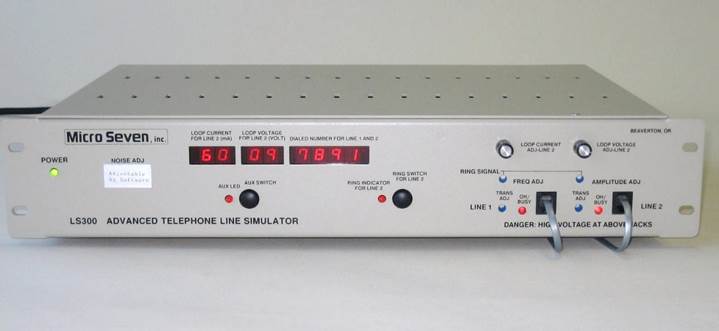
LS300 Advanced
Telephone Line Simulator for loop voltage 20-60V and loop current 20-60ma
adjustable
We have
provided MINI-PBX SIMULATORs (Telephone line simulator, or Central Office
Simulator(C.O. Simulator) to telecommunication equipment manufacturers for many
years. Our instruments simulate public telephone lines for many different
characteristics. Our instruments provide 2, 4, 8, and 32 simulated telephone
lines for testing and demonstrating telecommunication equipment
LS25 , The Cheapest Telephone Line Simulator,
model LS25 in a smaller case than model LS15s provides complete telephone line
simulator function for one-calling direction. All programming is done by
dialing unique codes into LS25. All programmed parameters except hot line mode
are restored upon power on/off operations. It contains programmable telephone
numbers, dual-frequency call-progress tones, 30Hz square-wave ring-signal,
stutter dial-tone, forced called-party disconnect, programmable network
response delay, programmable disconnect signal, simulated PBX mode, hot-line
mode, random noise generation simulating bad telephone line, secondary call
progress tone, and optional accessories (car-battery adapter and International
AC/DC power adapter options). It accepts both rotary pulse and DTMF dialing
methods. LS25 only requires 24VDC input power, and it includes standard AC/DC
power adapter for 117VDC input power. For international operations,
International AC/DC power adapter option for LS25 is requires. Specifications
are subject to be changed. On-line manual is available below.
Lower-cost model, LS25A, Dial-tone simulator without ring-signal generation is
available with or without battery operation.
LS15 battery-operated and hand-held
telephone line simulator with programmable telephone numbers, dual-frequency
call-progress tones, 20Hz ring-signal, caller-ID, caller-ID on call waiting,
stutter dial-tone, many test tones, distinctive ring-signal, forced called-party
disconnect feature, programmable network response delay, programmable
disconnect signal, simulated PBX mode, hot-line mode, sleep mode (automatic
power shut-down), line impairment mode with extra signal attenuation and random
noise addition, secondary call progress tone, and optional accessories
(car-battery adapter and carrying case) The RS232C interface or outside-line
interface is also available for non-battery version, model LS15-1. The RS232C
option provides programming of telephone numbers, signal attenuation, caller-ID
and other parameters from Control Software in PC. An outside-line interface is also available
as an option. The simplified message delivery interface, SMDI , which provides
visual message display with serial interface is also available as an option.
The European caller-ID ETS format and Bellcore format is available in model LS15-1-ETS with serial
port and control software for programming. International power supply option
provides four different power plugs for 90-250V AC input. LS15-N simulates
Japanese telephone line including Japanese caller-ID standard.
LS15-C1 replaces LS15-C with restoring
programmed parameters upon power on/off operations. It is lower-cost new
generation telephone line simulator with programmable telephone numbers,
dual-frequency call-progress tones, 20Hz ring-signal, stutter dial-tone,
distinctive ring-signal, forced called-party disconnect, programmable network
response delay, programmable disconnect signal, simulated PBX mode, hot-line
mode, programmable extra signal-insertion loss, secondary call progress tone,
and optional accessories (car-battery adapter and 230V AC/DC adapter). It runs
with a provided AC/DC adapter. The RS232C option provides programming of
telephone numbers, signal attenuation, caller-ID and other parameters from
Control Software in PC. The RS232C option also displays DTMF/dialing pulse
digit inputs. An outside-line interface is also available as an option.
International power supply option provides four different power plugs for
90-250V AC input. Audio monitor option with a internal speaker is available as
an option.
LS110-4 and LS200-8A, our most
popular 4, and 8-line MINI-PBX SIMULATORs (telephone line simulator or CO
simulator) with single-digit and programmable telephone numbers, pseudo-line
impairment with random noise and 20dB signal attenuation, disconnect signal,
network delay, PBX mode, stutter dial tone, distinctive ring signals, call progress
tone selection between single and dual frequencies, transmit power adjustment
potentiometer for each line, off-hook/busy LED, and ring signal. Please ask for
3-way calling option/feature with no charge. Options are Multi-Line DTMF Dialer
Option, Line Impairment Option, 20Hz Ring Signal Option (adjustable for
frequency and amplitude), Caller-ID option, Serial port Option, Audio Monitor
Option, and Outside-line Interface Option. The model LS200 may also be used as
a rack-mount.
LS300, Advanced Telephone Line Simulator with
displays of dialed numbers, loop current, loop voltage, and RMS voltage
display. It equipped with potentiometers for adjusting loop current and loop
voltage, programming of frequency attenuation characteristics and random noise
insertion, dual frequency call progress tones, adjustable ring signal for
frequency and amplitude, distinctive ring signal, front-panel ring switch, and
optional Caller-ID or Line Impairment Options. It may be used as a rack-mount.
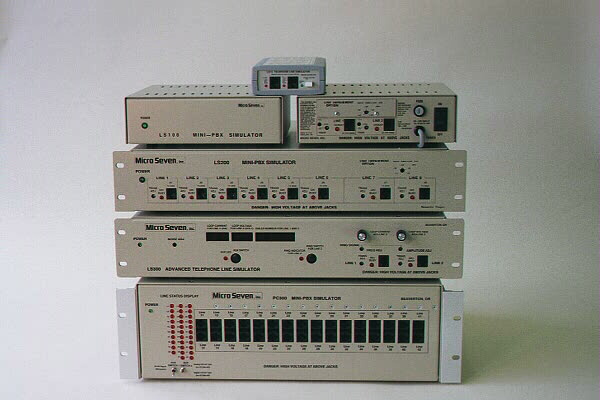
Products
shown in the above picture are:
LS15
(top)
LS200-8A
LS300
PC300
(bottom)
MICRO SEVEN, INC.
Hillsboro,
OR U.S.A.
e-mail:
mailto:sales@microseveninc.com