Alarm Test
System, Ademco Contact-ID Alarm Receivers, Alarm Monitors, Alarm Panel Testers,
SIA-format type Alarm Receivers Dialers and Ethernet/Internet dialer. Wi-fi
instead of Ethernet interface is available for some models.
Apple, the Apple logo, iPhone, and iPad
are trademarks of Apple Inc., registered in the U.S. and other
countries and regions. App Store is a service mark of Apple Inc
TripleQ, Alarm
Receiver/Simulator and Alarm Panel Tester for Contact-ID, SIA-FORMAT, and pulse
4X2 messages wirelessly to iPhone® app.
AP15q, Alarm Dialer,
transmits Contact-ID, SIA-
FORMAT, and pulse 4X2 messages wirelessly from iPhone® app.
ATS1000, New Alarm Test System for monitoring incoming alarm
signals, transmitting alarm signals at remote alarm panels,
and testing both central station telephone line, testing remote telephone lines
and testing alarm receivers
Contact-ID alarm receivers with or without Random Noise
Option for testing alarm panels with signal impaired handshake and kiss-off
tones with random noise: (some alarm receivers can also deliver received
messages to other alarm receivers as a dialer.)
Note: FXO interface is regular telephone line input. FXS interface provides
simulated CO line.
CT10 (FXO interface), CM10
(FXS interface), CT200 (2 ports, FXO or FXS interface),
CT400 (4 ports, FXO
interface), CT800 (8
ports, FXO interface),
LS15E+ (FXO and
FXS), LS15E+/TRIPLE
contains Contact-ID, 4x2 Pulse, and SIA-FORMAT protocols.
LS15-E (FXS interface with
Listen-in feature to telephone set and also include two telephone line
simulators
LS15 SIA FORMAT, SIA
FORMAT alarm-receiver, two simulated CO lines with 2-way audio/listen-in model
Alarm panel for Ethernet/Internet and/or telephone line:
IP104, with two loop detections as a new alarm panel
transmitting IP/DC-09 type messages with conventional telephone dialing
function and email/text message transmission to your smart-phone or PC
Alarm
monitor:
IP108 System , IP108 inputs alarm messages from alarm panels by simulating
telephone line and alarm central station receiver. IP108 transmits converted IP
messages to IP receiver, ER15B over Internet. ER15B sends serial messages to PC
using the Automation Protocol.
IP105, for surveillance and
recording alarm signals, eave-dropping
Contact-ID alarm message traffic on telephone line and send IP messages over
Ethernet/Internet at either at alarm panel or at alarm receiver. It contains
history file in EEROM.
IP105X for
monitoring contact-ID messages at existing alarm panel installed and recording
them in non-volatile memory as a stand-alone operation without PC. History file
may be read at on-site or at test bench via RS232 interface.
Ethernet/Internet:
We have standard and proprietary IP alarm
monitor system with custom EM15 and ER15 and standard Contact-ID alarm panels.
EM15(Ethernet/Internet
dialer with FXS interface from your alarm panel, desk-top unit, and telephone
line replacement in TCP and UDP protocol. Sending email is included.)
LS15ETH, IP Alarm Message
Transmitter-Ethernet, simulated CO interface (FXS) and telephone line interface
(FXO)
AP30, RS232/IP
TRANSCEIVER, for transmitting and receiving DC-09 type messages and also
email/text message transmitter into Ethernet/Internet with RS232 interface
ER15A (both TCP and UDP
for receiving DC-09 alarm messages from Contact-ID (ADM-CID) and SIA-FORMAT
(SIA-DCS) with or without encryption from
multiple sockets)
RAP15
(Ethernet/Internet telephone dialer receiving custom TCP commands as
TCP-server) RAP15-1
(Ethernet/Internet) for stand-alone central station testing RAP15-2
(Ethernet/Internet telephone dialer for receiving DC09 type commands, custom
TCP commands as TCP-server, and HTTP1.1 command. RAP15-3 for receiving
http commands for sending DC09 messages to DC09 IP receiver or sending
Contact-ID message over telephone line to DC05 central station.
DC09tester in software
for providing both DC09 transmitter (encryption both Contact-ID and SIA-FORMAT)
and receiver (Contact-ID and no encryption) for starting DC09 project or
verifying compatibility
Stand-alone Contact-ID alarm receivers with built-in
display:
IP107, LCD display
and audio monitor for Contact-ID, Pulse 4+2 and SIA-FORMAT (NEW)
Contact-ID, SIA-Format, and pulse 4X2 PC dialer and
Alarm Panel Simulator:
AP70,
RS232 AP80, USB
MicroAP1 for PCB
assembly providing most of AP70 features
Contact-ID dialer from PC or Alarm Panel Simulator:
AP15-3,
telephone dialer from PC
AP15q, Alarm Dialer,
transmits Contact-ID, SIA-
FORMAT, and pulse 4X2 messages wirelessly from iPhone® app.
AP30, RS232/IP TRANSCEIVER, for
transmitting and receiving DC-09 type messages and also email/text message
transmitter into Ethernet/Internet with RS232 interface
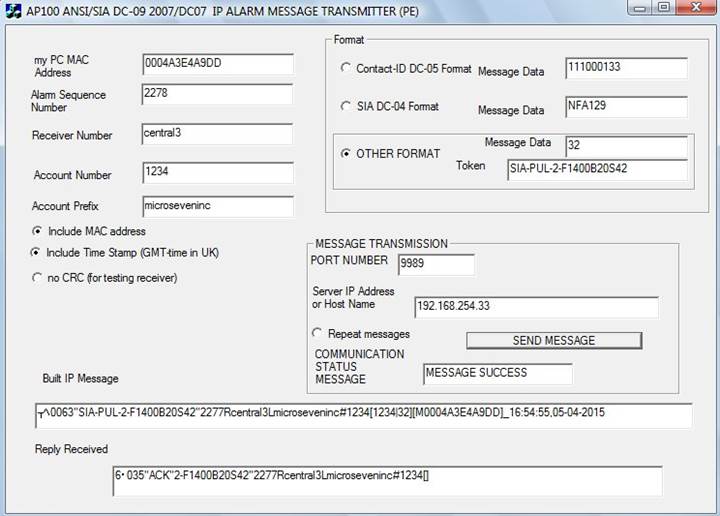
AP30, RS232/IP
TRANSCEIVER, for transmitting DC-09 type messages into Ethenet/Internet with
RS232 interface
Micro Seven, Inc.®
1095-K
N.E. 25th Ave., Hillsboro, OR 97124, U.S.A.
Phone:
503-693-6982, Fax: 503-693-9742
e-mail:
mailto:sales@microseveninc.com
All
products are made in U.S.A.